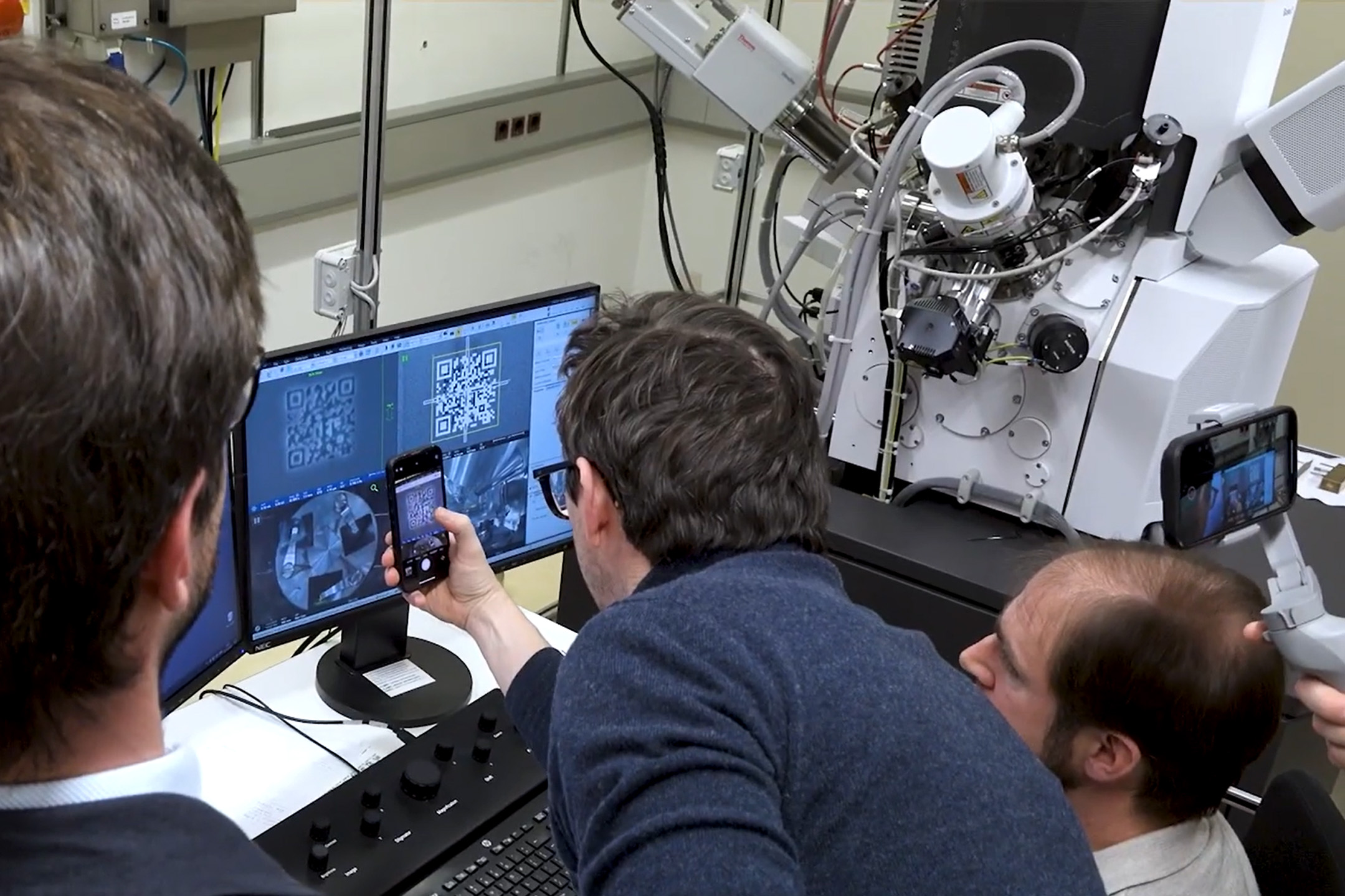
Getting into the Guinness Book of Records with the world’s smallest QR code might sound like a technological gimmick, but it actually bears a promise of great potential for long-term data storage. Researchers from the Institute of Materials Science and Technology at Vienna University of Technology/TU Wien have been working with the Austro-German data storage technology company Cerabyte to develop a mini QR code with an area of 1.98 square micrometers, making it smaller than most bacteria. It can be read only with an electron microscope, but the ceramic material into which it is milled is stable and durable, promising new opportunities for long-term, energy-efficient data storage.
It is not the size of the record-breaking QR code that is remarkable, though; manufacturing structures on a micrometer scale is no longer that unusual, and it is now even possible to fabricate patterns made of individual atoms. This cannot be used to generate stable QR code, however, as the atoms can move to other positions and the information is thus lost. The material is the crucial factor; thin ceramic films are used to coat high-performance tools, and the material remains stable and durable even under extreme conditions, making it ideal for data storage. Conventional magnetic and electric data storage media are short-lived, and data stored in this way can be preserved only with constant energy input, elaborate cooling measures and regular data migration. Early cultures carved their information in stone, and such inscriptions can be read to this day – ceramic data storage media adopt a similar approach.
The research team milled the QR code into a thin ceramic layer using focused ion beams. The individual pixels are 49 nanometers in size (the wavelength of visible light is something like ten times the size). The code is thus completely invisible, as it is physically impossible to resolve its details using visible light, but the QR code can be reliably read with an electron microscope. The storage capacity promised by this method is similarly impressive; more than two terabytes of data can be stored on an area the size of an A4 sheet of paper.
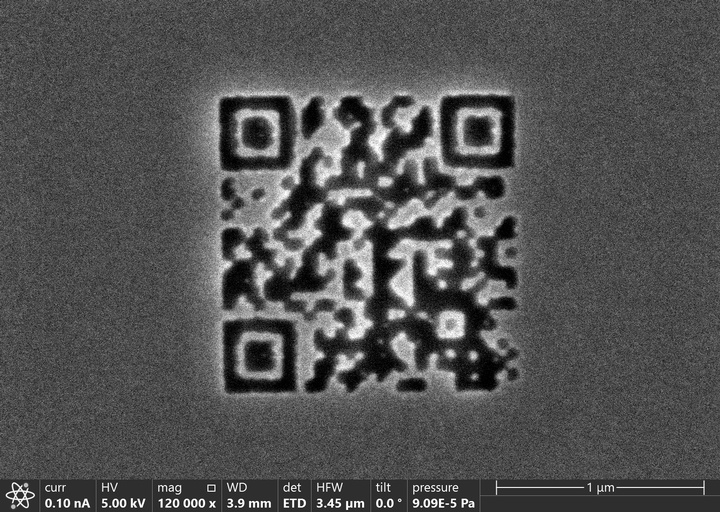
The world’s smallest QR code. The link it opens will take you to Vienna University of Technology’s Research Group for Thin Film Material Science.
The University of Technology researchers are striving to expand the insights the world record has brought them, using other materials, increasing the writing speed and developing scalable manufacturing processes so that ceramic data storage can be used outside the laboratory (e.g. in industrial contexts). At the same time, they wish to find out how complex data structures – beyond simple QR codes – can be written and read quickly, robustly, and energy-efficiently on thin ceramic films.
A technological gimmick? Anything but – they are setting a more environmentally friendly course for the future of data storage.