
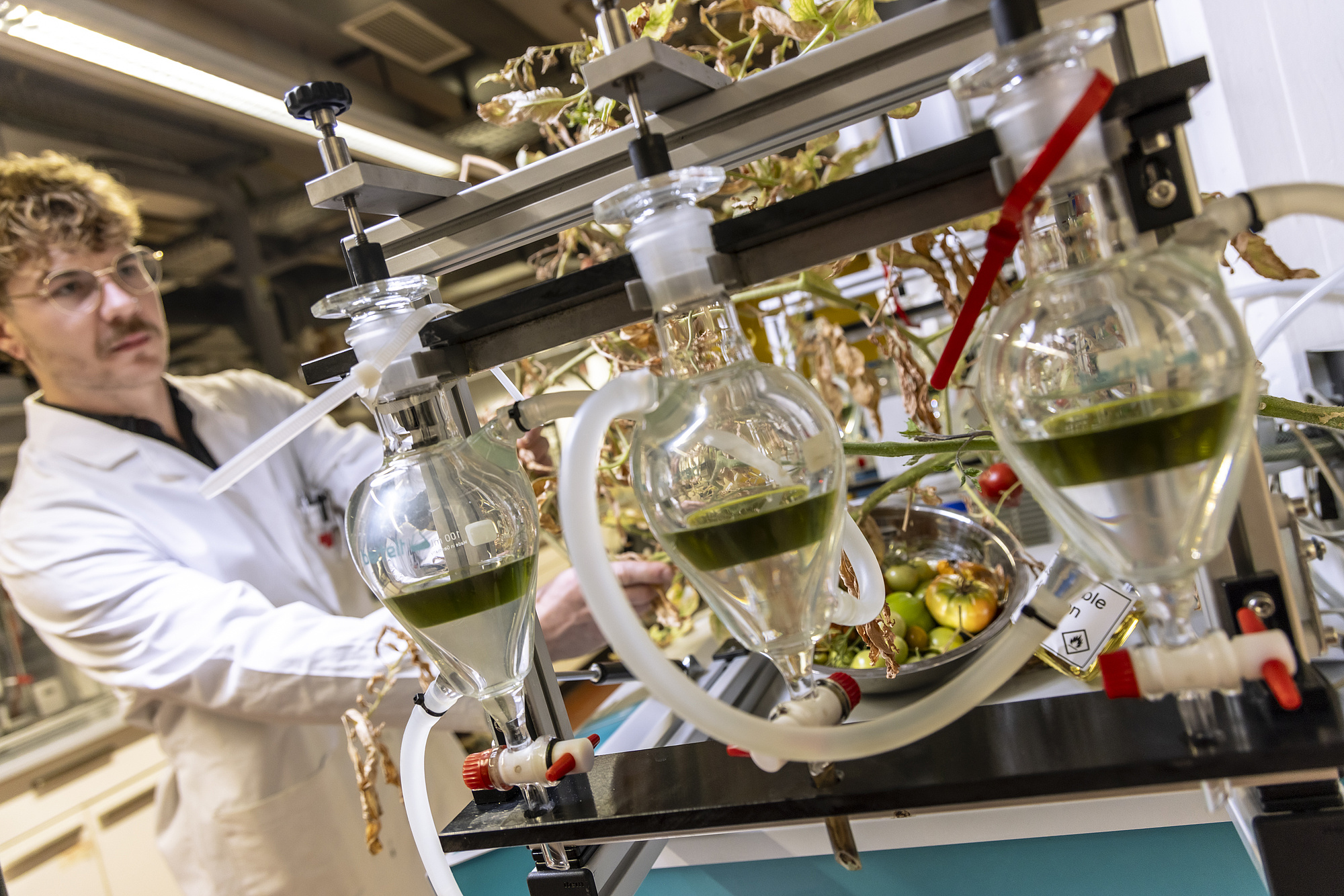
It’s the European Green Deal – Europe is striving to be climate neutral, but this objective can be achieved only if CO2 emissions can be successfully reduced in the aviation sector. Researchers are thus working round the clock to find out what the propulsion technology of the future will have to be capable of, and how sustainable fuels can be manufactured.
Fuel accounts for 50% of the operating costs for long-haul flights – but which fuel is suitable, and how should engine technology be appropriately adapted to make flights possible? Answers to these questions are currently being researched in places like the laboratories of the FH Joanneum Graz in Austria. There are currently great hopes for hydrogen; when used as a fuel, it causes zero CO2 emissions and it is more efficient than kerosene when converted to energy.
An EU project is currently addressing the question of how “Sustainable Aviation Fuel (SAF)” can be manufactured, with eleven research institutions from six countries working on the task since the beginning of the year. The ToFuel project is headed up by Graz University of Technology with the aim of developing a biorefinery concept that is waste-free and CO2-neutral while producing an aviation fuel that is sustainable and also economically competitive. And it’s all based on tomato residues.
Tomatoes are the second-most consumed vegetable in the world (after the potato), but if you are looking for the vegetable that is processed the most ways, the tomato wins hands-down (as salad, concentrate, passata, ketchup, pasta sauce, conserves and a whole lot more). Greenhouses and modern technology make it possible to grow fresh produce all year round, whether you’re in China, India, Türkiye or the USA. The EU is the third-biggest producer, with a harvest of 17 megatonnes of tomatoes, but not all of the plant can be used; blossom, leaves, stalks, skins, seeds and sub-standard tomatoes are currently incinerated or disposed of as agricultural waste. There is great potential here, however; the project manager estimates that it will be possible to cover some 3% of Europe’s Sustainable Aviation Fuel requirements using the residues from tomato production by 2030.
The motto could be “off the stalk and into the tank” – the plant residues must first be processed so that micro-organisms can break it down efficiently and the project is currently testing two fractionation technologies for this: biomass is subjected to heat and pressure during extrusion and then broken down into its cellular components via rapid reduction in pressure; in hydrothermal liquefaction, the biomass is exposed to high temperatures and pressure to transform it into bio-oil and bio-char. These two approaches are being examined and compared. The next stop involves cleansing the bio-oil of azotic compounds before it can be refined into fuel.
In addition to sustainable aviation fuel, they are also creating fertilisers, animal feed, and cooking oil. The project is also examining the ecological, economic and social impact of these technologies, not least as it may open up a new source of revenue for foodstuff processing.
Another hot topic of interest to Graz University of Technology is to be found at the business end of an electron microscope. Biological samples are treated with a staining agent to make their tissue structures easily identifiable so they can be examined under the microscope. The standard agent in use is uranyl acetate but, for safety reasons, this highly toxic and radioactive substance cannot be used in every laboratory. Researchers at this Austrian university have now discovered that espresso coffee is not only an equally effective alternative but is also environmentally friendly, harmless and cheap. Taking their inspiration from the circular dried stains left in coffee cups, their tests with algal samples returned promising results, as did a direct comparison with uranyl acetate; in some cases, the contrast values were even better. Further investigation using different tissue types is nonetheless still required for any broad application in biological electron microscopy – so coffee is still the driving force behind research on all kinds of levels.
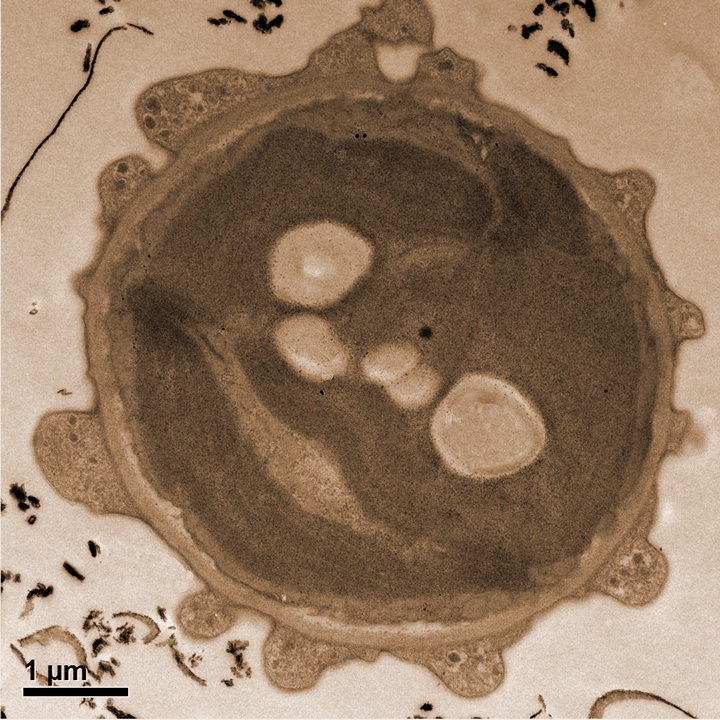
The picture shows an electron microscope image of an alga sample that has been pre-treated with espresso to obtain a stronger contrast.


