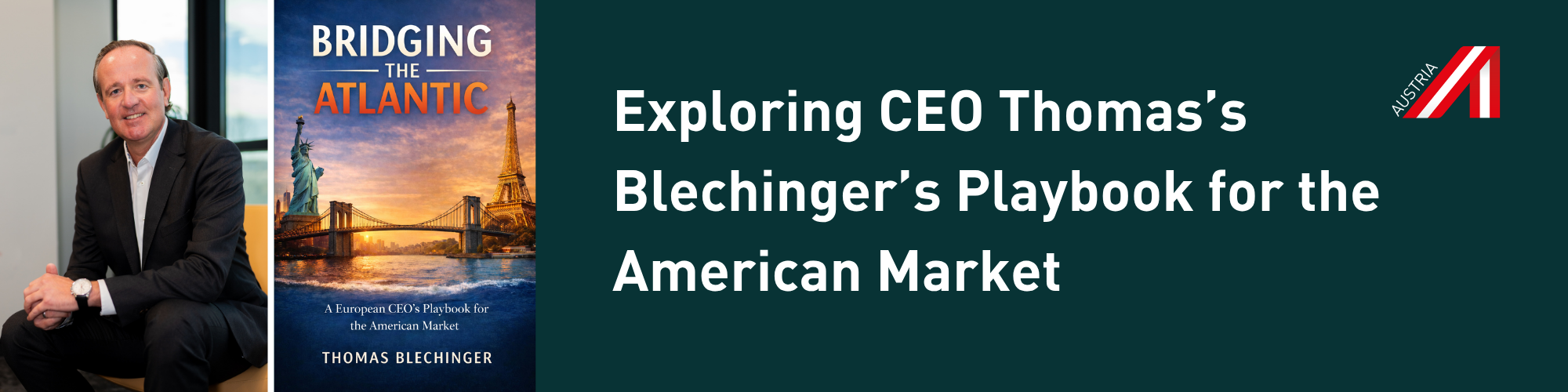
Thomas Blechinger serves as President & CEO of Plasser American since 2016. The company currently employs around 350 people and generates more than $100 million in revenue in the United States.
Plasser American is the U.S. subsidiary of Plasser & Theurer, an Austrian company that manufactures track maintenance machines for the railway industry. Mr. Blechinger is the author of the new book Bridging the Atlantic, an honest and practical guide for European leaders entering the U.S. market. We spoke with Mr. Blechinger about his experience in the U.S. market and his insights for companies looking to expand.
Responses have been edited for length and clarity.
ADVANTAGE AUSTRIA USA: Why did Plasser decide to expand into the US market?
Thomas Blechinger: Plasser American was founded in 1961 in Rockford, Illinois, and we have been at our current location in Chesapeake, Virginia since 1970. The company has deep American roots.
The United States is the largest railroad market in the Western world. The rail network alone spans roughly 140,000 miles, Austria, by comparison, has about 3,000 miles.
For a technology company like Plasser & Theurer, having a presence in this market is a strategic imperative. On top of that, metro and transit systems in North America increasingly needed to invest in track modernization, that created a natural demand.
The U.S. market was identified as a growth market, and we decided to expand our operations in the U.S. and make significant investments there. Under my leadership, the company has undergone the most comprehensive investment program in its history: we doubled production capacity, built a modern office building, acquired a technology startup, and made targeted investments in new business areas to diversify our income streams. In total, we invested approximately 85 million dollars between 2020 and 2023.
The opportunities were and continue to be enormous: the infrastructure push of recent years, the Infrastructure Investment and Jobs Act, and the growing awareness of the importance of rail infrastructure have further energized the market. But the challenges were equally real. American business culture differs fundamentally from its European counterpart. In Austria, we plan long-term and in detail. In the US, the expectation is that you deliver results quickly and adapt pragmatically.
You also cannot underestimate the regulatory differences, from Buy America requirements to labor law frameworks to entirely different expectations around sales and customer relationships. After 20 years in the US, I can confidently say that anyone who thinks they can simply copy their European business model across the Atlantic will quickly learn otherwise.
ADVANTAGE AUSTRIA USA: What inspired you to write your book “Bridging the Atlantic — A European CEO’s Playbook for the American Market”?
Thomas Blechinger: Over many years, I watched European companies, including truly brilliant and innovative ones, stumble when entering the US market. At first, I thought it came down to the quirks of individual executives: their communication style, personal misjudgments, or a lack of adaptability. But over time, I recognized a pattern. It wasn’t individual failure, it was a structural problem. The same stumbling blocks kept appearing again and again: a different communication culture, a different definition of speed. Things that don’t appear in any business plan, but that determine success or failure.
At the same time, there was no book that truly built this bridge, no practice-oriented work by someone who knows both worlds from the inside. I published this book because, as an Austrian CEO in Virginia, I’ve made this journey myself. Every lesson is based on real experiences, my own, and those of many European executives I’ve encountered over the past 20-plus years.
ADVANTAGE AUSTRIA USA: On LinkedIn you recently wrote: “Success doesn’t automatically travel. What works in Vienna doesn’t automatically work in Virginia. What earns trust in Munich doesn’t necessarily resonate in Michigan.” How did you arrive at this insight? Were there specific situations or experiences in your career that made this particularly clear?
Thomas Blechinger: This insight didn’t come overnight; it built up over many client meetings and negotiations. A key moment was when I understood how differently products are presented in Europe versus the United States.
In Austria or Germany, you typically start a sales presentation with the company’s history, certifications, and technical specifications. You demonstrate that you’ve been in the market for decades, that you’re ISO-certified and comply with all other sorts of European standards, that the engineering behind the product is first-class. And it works, because in Europe, trust is built through proof of competence and a long track record. The customer thinks: this company has been around for 100 years, they know what they’re doing.
In the US, I walked into meetings with exactly this approach, and quickly realized the reaction was completely different. My American customers didn’t want to hear a company chronicle.
The first question was: What problem does this product solve for me? The second: What’s the ROI? And the third: How quickly can we test it?
Certifications and company history are nice, but in the US they don’t come at the beginning of the conversation, they come, if at all, at the end as confirmation.
That sounds simple, but this shift requires a fundamental rethinking of how you communicate, present, and build relationships. It’s not that one approach is better than the other, it’s that success doesn’t automatically travel. You have to speak the language of the market you’re in.
ADVANTAGE AUSTRIA USA: Can you share any further recommendations or insights from your new book?
Thomas Blechinger: Gladly. One core recommendation I give every European executive is this: invest in cultural understanding before you invest in infrastructure. Too many companies open offices, hire staff, and sign leases before they truly understand how the American market works.
Three concrete recommendations from the book:
First: Hire Americans who understand your business and listen to them. That sounds obvious, but I repeatedly see European companies hire local managers and then ignore their suggestions because they don’t fit the European model.
Second: Adapt your communication. Americans communicate more directly, more optimistically, and more results-oriented. A sales pitch that works in Frankfurt, data-driven, detailed, cautiously worded, won’t have the same impact in Houston. In the US, you need to lead with the vision and follow up with the details.
Third: Give your US subsidiary real autonomy. That doesn’t just mean a legal entity, it means operational independence in the areas that are critical for local success: pricing, personnel, customer relationships. The most successful European companies in the US operate on a federated model, with guidelines from headquarters, but local execution capability. When every decision has to go through headquarters in Europe, you lose speed and credibility.
ADVANTAGE AUSTRIA USA: How do you currently view the US market as an investment destination for Austrian companies?
Thomas Blechinger: To me, the United States remains the country with the pro-business mindset, bar none. The US market continues to be one of the most attractive investment destinations worldwide for Austrian companies — but it also demands more strategic care than ever before. On one hand, we see massive investments in infrastructure, a growing emphasis on onshoring and domestic manufacturing, and a political environment that favors local production. For Austrian industrial companies with strong manufacturing capabilities, that’s a tremendous opportunity.
At the same time, we’re operating in a dynamic geopolitical and trade policy environment. Tariff policies, Buy America regulations, and regulatory requirements are shifting, and Austrian companies need to be flexible enough to respond. Anyone who wants to succeed in the US today must be prepared to produce locally, build local value creation, and position themselves as an American company with European roots, not the other way around.
The opportunities are real, but success doesn’t come on its own. Austrian companies bring fantastic quality, innovation, and engineering excellence. But to translate that into commercial success in the US, you need cultural adaptability and the willingness to establish yourself as a local partner, not as a European exporter.
Of course, I could tell you a lot more, but it’s all in the book. The U.S. is still the land of opportunity—if you go about it the right way.
ADVANTAGE AUSTRIA USA: Where can readers connect with you and where can they find your new book?
Thomas Blechinger: With pleasure! The English and German editions of my book, “Bridging the Atlantic,” are available on Amazon.
You can find all information on the book’s website at www.BridgingTheAtlanticBook.com.
And of course, you’re welcome to connect with me directly on LinkedIn.