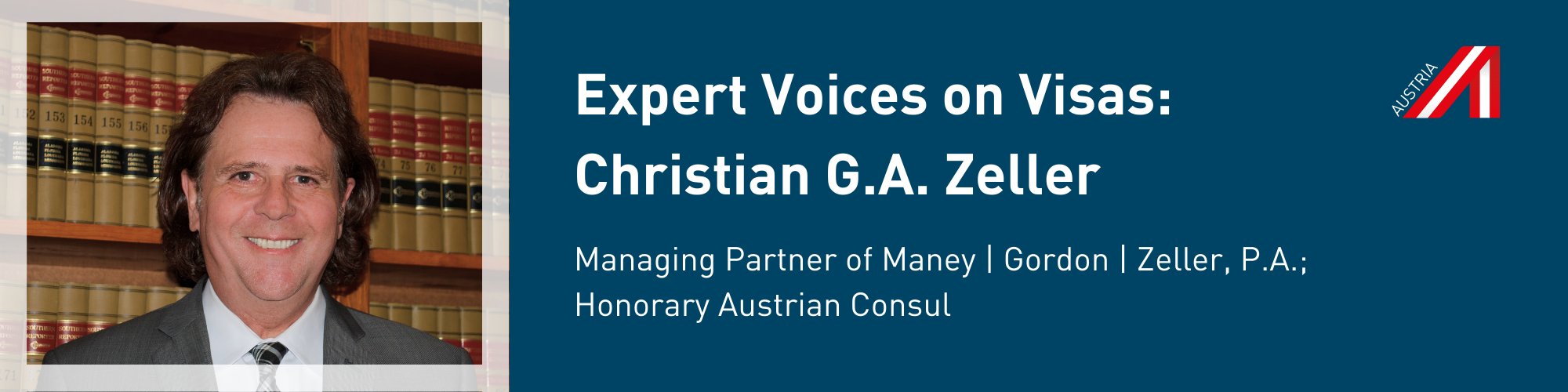
Visas and immigration are hot topics right now for both foreign-owned and domestic companies in the US. We spoke with Christian Zeller, Managing Partner of Maney | Gordon | Zeller, P.A., and Honorary Austrian Consul, about some of the most common visa questions relevant for Austrian companies as well as Austrian students and employees in the US.
Note: This article is provided for informational purposes only and should not be taken as legal advice. Please contact a qualified attorney with specific questions. Answers have been edited for length.
What is the work visa situation in the US at the moment? Any changes people should be aware of? Any recent policy or enforcement trends?
Well, the visa situation really hasn't changed, but enforcement and visa issuance certainly have changed. For example, if you apply for a visa now, there is a different vetting process at U.S. consulates and embassies overseas and it might take a little longer to receive a visa. The biggest issue being the social media vetting where our consulates really dive into five years of your past online, and if there's anything derogatory against the United States, that might become an issue for a visa.
State-side, we have seen more audits at companies where the Department of Homeland Security actually shows up and checks whether that person who has an H-1B visa is actually working in that H-1B job, or if they have an L visa, if that is really an L visa job and so forth.
Are there steps visa applicants can take in response to the social media vetting?
Deleting your Instagram is going to raise a flag because you have to disclose your social media handles for the past five years. So, if your interview is on Tuesday and you erase all of your profiles on Monday, that's not a good idea, but it's a good idea to clean it up. Check your likes and comments; you can always make adjustments in that direction. But I would not delete it.
What I am concerned about is, especially LinkedIn, where we all brag about how great we are in our jobs. You bloat your resume and that can become dangerous. You can have an Austrian working for an Austrian company who is sent stateside several times on his B2 visa or on his ESTA just to do something. But on his LinkedIn, he puts “Sales Manager North America” because he's been here three times. During the visa application process, that's going to sink you.
Do you anticipate any changes in employment-based immigration in the next few years?
Yes, not in all visa categories, but most definitely in the H-1B visa category. We already see this now. The upcoming H-1B visa lottery is already changing that paradigm where the government is looking to bring in what they call the “best and the brightest,” and it's all measured by wages. So, people who are being paid a higher wage have a higher chance in the lottery of being selected. Some of those things may tend more towards a merit-based system, especially when we talk about the H-1Bs.
We have seen more scrutiny in E-B1A applications—persons of extraordinary ability—and in E-B2 applications—persons who work in professions that are in the national interest. The government looks at that more closely now and is much harsher in adjudicating those applications.
What are the most common visas for Austrian companies sending people to the US?
Thankfully we have not experienced anything negative with our Austrian companies in terms of visas. We often encounter ESTA questions, though ESTA is not a visa. We also commonly deal with the B-1 visa if we have technicians and installers come over or trainers come over, but mostly we deal with E-1 treaty traders, E-2 treaty investors and L-1A intercompany transfers and L-1Bs are the intercompany transfers for specialized workers.
What can companies gain from sponsoring employee visas?
If I'm an Austrian company and I bring an Austrian employee with me, then obviously I know who I'm hiring, and I bring my expert with me. So, there's an obvious benefit to that, and especially in the E visa categories, it's a rather simple way to do that.
But there's also benefits in hiring locally here in the US. Many people talk about hiring students who have graduated, and they are great employees because anyone who graduates with a bachelor's or a master's degree gets a year of optional practical training (OPT) where they can work within the industry. The job offered to them has to be a function of their degree, so if you have a mechanical engineer, you cannot employ that person as a restaurant manager.
But there's a great pool of young professionals out there that have employment authorizations for one year, and it's a great opportunity for an employer to test a new employee because they already have work authorization, and then the employer can make a decision whether they want to continue to petition for that person.
Are there any common misconceptions that international students might have about working in the US after they graduate?
I see misconceptions when I speak with prospective students that are still in Austria or any other country and who have not come stateside yet. I do not see that with existing students. Universities are very well versed in educating those students. I speak at universities all the time on these subject matters to educate students as to what comes after they graduate. It's always the same path: They have the optional practical training for one year. Those who have graduated with a STEM degree get an additional two years of employment authorization, which is a huge benefit for those students and for their employers. And there’s a period of three years where you can employ someone before you apply for another visa category.
I would not so much call it a misconception, it's more being too nonchalant about it.
Students, once they're here for several years, everything becomes normal, everything is good. And the enforcement is becoming a bit harsher. So if you have a run-in with the law, there's a good chance your student visa is going to be canceled. You can be arrested and not convicted, and your student visa is going to be canceled.
There can be other issues, and your visa is gone, or you might overstay your visa. All those things, you must stay away from now. You have to play it by the book, and that's the only way to do it.
What questions do you get most frequently from companies, employees, or students when it comes to visas in general?
Students really just want to know what the path is, and it’s more a reconfirmation of what they already know. I'm pleased to report that students are very well educated, typically about the visa process.
The questions we get mostly from Austrian companies are, they have a certain type of issue or a certain type of project and they want to know what kind of visa they are going to need to resolve that particular issue because it's typically something that falls outside what they normally do. Lately we get more inquiries because there's the panic about the ESTA being changed. In the past, travel to the US was more nonchalant, and that door seems to be closing.
I see a lot of companies upgrading their visa categories—steering away from the ESTA, steering away from the B-1, getting into an E or an L, getting employees into H-1B or maybe O-1s, whatever fits the profile.
Do you have any additional thoughts about the ESTA situation?
If you have an ESTA now, use it, and if your ESTA is running out, renew it, because the new rules are not in effect yet. It's likely going to be mid-2026 that the new ESTA rules come out, and we don't know yet what they will be. The government is now reevaluating as to what they will implement or not, but we do not have any final word on that yet. For now, continue to use ESTA as you have.
Is there anything else that people should know on the topic of visas?
We all read the papers and there's lots of panic. A lot of those things are true and some of them are not. But we always only hear the bad stuff. We don't hear the good stuff. There are hundreds of thousands of people coming to the United States on a daily basis, and it all goes well. But you have to do it right. You should not be nonchalant about it. Times have certainly changed; the paradigm has shifted. We have to be more careful about how we go about visa applications, and we ought to make sure that we remain within the parameters of the law. That's all there is to it.
Christian G.A. Zeller, Esq. | Attorney at Law & English Solicitor | Board Certified in Immigration & Nationality Law | Consul of the Republic of Austria | Maney|Gordon|Zeller P.A. | Tampa, FL | c.zeller@maneygordon.com | +1 813-221-1366