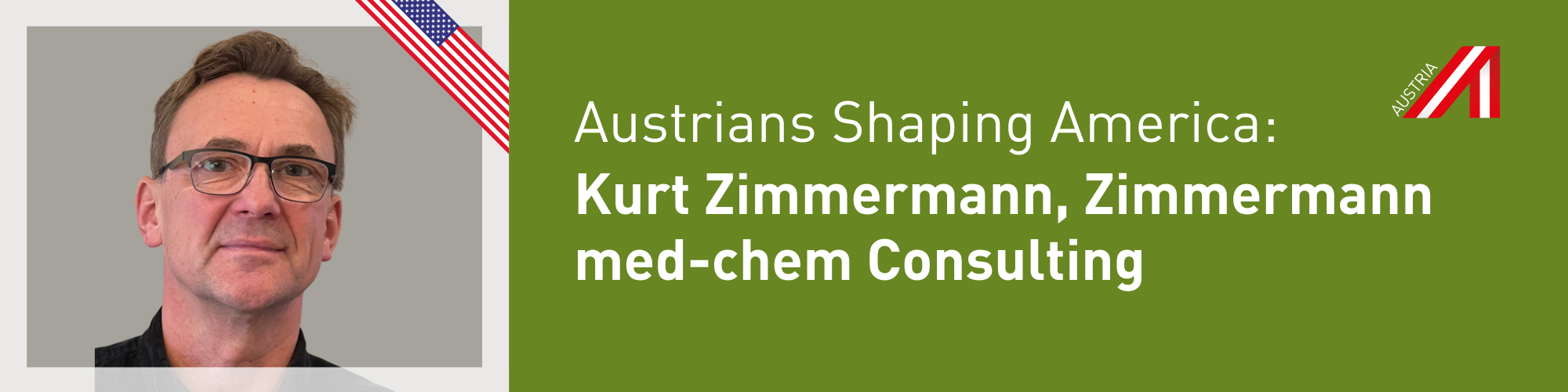
Kurt Zimmermann’s 30 years of experience as a chemist in Europe and the US has given him the full range of career experience. He’s gone from a large company to a startup, to running his own consulting firm.
Growing up in Lower Austria, Zimmermann earned his PhD in Organic Chemistry from the University of Vienna, followed by a postdoc at ETH Zurich. In 1996, he decided to travel across the Atlantic for a second postdoc at the University of Rochester in New York.
“At that time the job market in the United States was booming for chemists,” he said. “And if you have to be a foreigner anywhere in the world, the northeast of the United States is not a bad place to be.”
Zimmermann shifted his focus from wanting an academic career to pursuing an industry career, and he ended up getting a job at Bristol-Myers Squibb in Connecticut, where he worked for over 18 years in classical medicinal chemistry, pharmaceutical research, and drug discovery.
When Bristol-Myers Squibb announced plans to close their Connecticut location, Zimmermann moved from “Big Pharma” to Arvinas, at that time a two-year-old startup with 40 employees. Arvinas is a biotechnology company that focuses on the development of targeted protein degradation therapeutics.
“Instead of inhibiting disease-causing proteins, they want to tag them for destruction in the natural recycling program the body has for proteins - a somewhat different approach to drug discovery,” said Zimmermann. He worked there for nearly 10 years.
Now, Zimmermann is a self-employed consultant running his own LLC focusing on medicinal chemistry research. He is interested in working with a variety of companies throughout the industry and is looking to connect with Austrian companies as well.
Transitioning from a large company to a startup and then a self-run business has been “interesting and a good learning experience.” As a researcher-turned-consultant, Zimmermann is well aware of the progress being made in medicinal chemistry. One breakthrough that Arvinas worked on is called “induced proximity,” where a molecule is created that brings two proteins together, and the proximity of those two proteins causes a medicinal effect. This is being used to develop treatments for diseases including cancer.
“In the pharmaceutical industry, induced proximity was unknown 10 years ago and wasn't common five years ago, but has become very widespread now,” Zimmermann said. “And the newest thing is artificial intelligence and machine learning, which I think will be another great tool.”
When he’s not working, Zimmermann enjoys sharing his Austrian culture with his family and friends in Connecticut, making apricot dumplings for his family and regularly hosting what he calls “Schnitzelfest.”