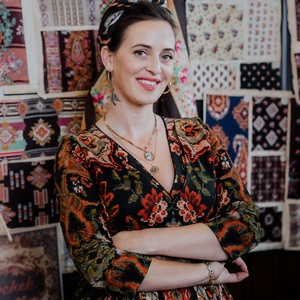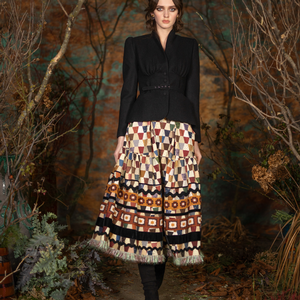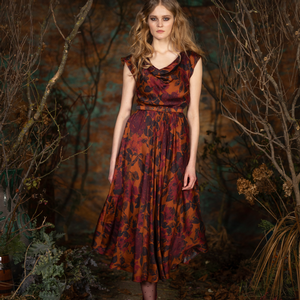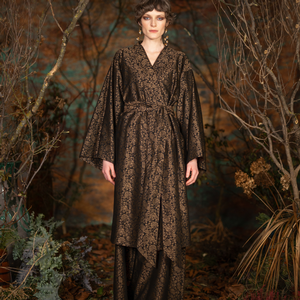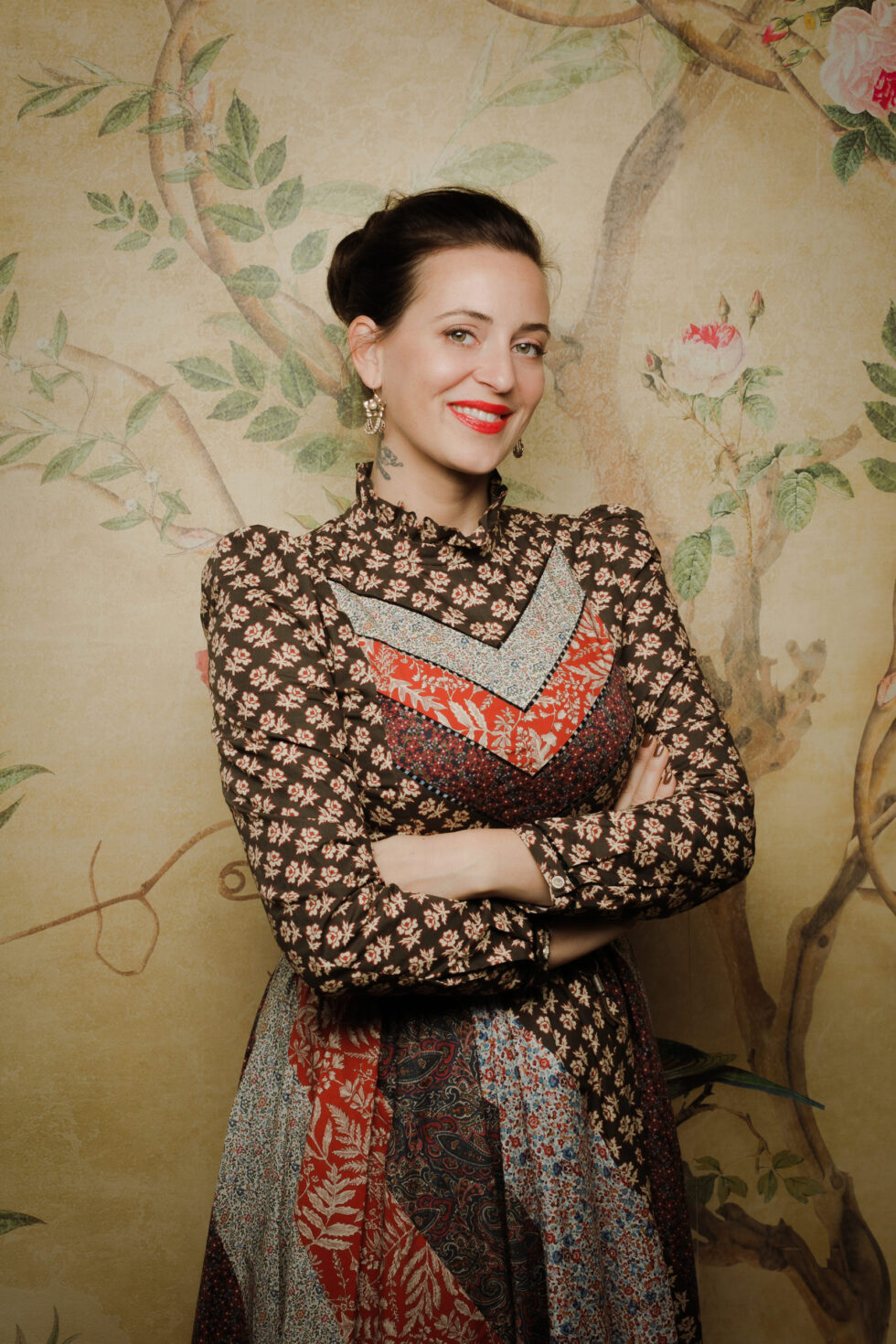
Lena Hoschek, one of Austria’s most renowned fashion designers, helped us explore her creative journey, the importance of Austrian craftsmanship, and her ambitions for the future. Born and raised in Graz, she studied fashion design at the Fashion School in Vienna at Schloss Hetzendorf before moving to London, where she worked for Vivienne Westwood. In 2005, at just 24 years old, she returned to Graz and founded her own label, Lena Hoschek.
ADVANTAGE AUSTRIA USA interviewed Lena Hoschek about her life and career, her creative process, and the role her Austrian heritage continues to play in her work. We also discussed the challenges and opportunities of building an internationally recognized Austrian fashion brand, her perspective on the U.S. market, and her plans to further strengthen the label’s international presence.
How has your Austrian background influenced your creative perspective and your work?
Very strongly. I grew up in Graz and trained in Vienna, and I believe Austria has shaped the way I look at fashion much more profoundly than I realized at the beginning of my career. We have an incredible tradition of craftsmanship, a deep appreciation for detail, and a very distinctive approach to clothing and traditional dress.
I have always been interested in where things come from and why they are made the way they are. Austrian traditional dress, in particular, embodies an incredible wealth of knowledge about tailoring, materials, and craftsmanship. That has certainly influenced my work. At the same time, I have never wanted to simply reproduce tradition. What interests me much more is how it can be brought into the present and combined with completely different influences.
I am very proud to be Austrian and have never tried to hide my background when working internationally. Quite the opposite: I believe that especially when you work internationally, you need to know where you come from and what you stand for.
What challenges did you have to overcome on your journey from Austria to the international fashion stage?
Building international recognition takes time and, above all, consistency. You cannot reinvent yourself with every new trend. I developed my own style very early on and have essentially remained true to it. At times, that was certainly the more difficult path, but in the long run, it is probably one of the main reasons why the brand has such a clear and recognizable identity today.
How do ideas evolve from the first sketch to the finished collection?
For me, a collection rarely begins with a single garment. Most of the time, it starts with a mood. It might be inspired by a journey, a film, music, a historical theme, a person, or sometimes simply a fabric or an image that sparks something in me.
Gradually, an entire world begins to take shape around it. I collect images, colors, fabrics, and references, and at some point this world starts to become very concrete. Of course, sketching is part of the process, but for me, a crucial part of the design happens through fabric and cut. I am a dressmaker, so I need to see a garment on the body.
In the atelier, we try things out, make changes, discard ideas, and start again. Sometimes something looks wonderful in a drawing but does not work at all when worn, or exactly the opposite. For me, that process is one of the most beautiful aspects of my profession.
How do you balance artistic vision with commercial requirements?
That is probably one of the most difficult challenges when you are both a creative and an entrepreneur.
I could probably create collections and develop new ideas endlessly, simply because I get excited about things very quickly. But of course, at the end of the day, a collection also has to sell. After more than 20 years, you know your customers very well. You know which cuts work, which products are important for the brand, and where there is room to experiment.
At the same time, I do not believe you should ever start designing solely based on sales figures. Eventually, a brand would lose its soul. Commercial reality has to be part of the decision-making process, but it should never become the only source of inspiration.
How do international markets differ from Austria?
Some of our Austrian customers have known the brand for many years and have a very personal connection to it. Internationally, people often first discover Lena Hoschek through the silhouettes, the prints, or certain particularly distinctive pieces.
Perceptions of femininity also differ from market to market. In some markets, customers are more adventurous when it comes to color, patterns, or bold silhouettes, while in others purchasing decisions tend to be more restrained.
For us, it is therefore important not to reinvent our identity for every individual market. Of course, you need to understand how a market works and what customers there are looking for, but the core message of the brand has to remain the same.
What has your experience been like working with international partners, particularly American retailers and media?
I find the American market particularly exciting because there is a great openness toward brands with a strong identity and a distinctive story of their own.
At the same time, the United States is, of course, an enormous and highly professional market. You have to build relationships, maintain a presence, and understand how retail, media, and communication work there. That is not something you can manage exclusively by email from Austria.
That is why personal interaction is particularly important to me. Right now, we are once again focusing very intensively on the American market and building new relationships with retailers, media, and partners there. For an Austrian brand of our size, this is a process that has to be approached very consciously and step by step.
What does an Austrian fashion brand need today to succeed internationally?
A distinctive signature. I think that is more important than ever.
Today, there is an enormous variety of fashion, and through social media you can see within seconds what is happening anywhere in the world. If you then try to look exactly like everyone else, it becomes very difficult to stand out.
You need to know what you stand for. Of course, you also need quality, reliable production, a strong team, and an enormous amount of perseverance. International expansion does not happen overnight.
And I do not believe you should try to shed your Austrian identity in order to appear more international. Heritage and craftsmanship can be tremendous strengths when interpreted in a contemporary way.
What developments are currently having the greatest impact on the fashion industry?
Speed is certainly one of the biggest changes. Social media allows trends to emerge incredibly quickly, and some of them disappear just as fast. At the same time, there is an overwhelming abundance of products and images.
But I believe this is also creating a counter-movement. People are beginning to think more carefully again about what they buy, how long they can wear something, and where it was made.
For me, fashion was never meant to be thrown away after one season. I want to create clothes that people love, repair, continue to wear, and perhaps even pass on one day. To me, that is far more sustainable than constantly inventing new terminology around sustainability.
Of course, digitalization is also transforming our industry enormously. But despite all the technology, clothing remains something very physical. A beautiful fabric, a perfect cut, and a wonderfully crafted dress cannot be replaced digitally.
How is Austrian design perceived internationally?
For me, Austrian design has a very strong connection to craftsmanship, quality, and tradition. We have an incredibly rich cultural heritage, ranging from traditional dress and textile craftsmanship to art, architecture, and design, and I believe that this connection is recognized and appreciated internationally.
What I find particularly fascinating is the natural way in which we engage with tradition. In Austria, craftsmanship techniques, certain materials, and particular garments are not merely historical artifacts. They remain a living part of our culture. For me personally, this is a tremendous source of inspiration. I very much enjoy working with traditional elements, but I never want to simply copy them. What interests me is how we can take this knowledge and use it to create something new and contemporary.
I believe Austrian design has a certain individuality and authenticity. It does not need to be loud to stand out. Its strength often lies precisely in its quality, in the details, and in things that have been made with a great deal of knowledge and care.
Especially when working internationally, I notice again and again how much this authenticity is appreciated. If you see your background not as a limitation but as part of your identity, it can become a tremendous strength.
What projects are you currently working on? Are there any upcoming fashion shows, presentations, or international activities you are particularly looking forward to?
There is a lot happening at the moment. At the beginning of October, we will present our collection in Paris at Première Classe, and immediately afterwards we will travel to Morocco, where we will shoot our upcoming Spring/Summer collection.
I am particularly excited about this project because the collection is strongly inspired by Morocco, by its colors, architecture, markets, and above all its traditional craftsmanship. For me, it therefore became clear very quickly that we needed to photograph the collection there as well. I am looking forward to bringing to life, on location, the world that emerged in my imagination while developing the collection.
What goals would you like to achieve with your brand over the next few years?
After more than 20 years, my perspective on success has certainly changed. Today, I am less interested in constantly doing more and more. Instead, I want to continue developing what we have built with quality and consistency.
One of my greatest priorities is preserving craftsmanship and knowledge. For me, fashion is not simply a beautiful image. Behind it are patterns, fabrics, construction, and people who truly master their craft. That knowledge must not be lost.
At the same time, I want to continue developing the brand in a way that allows it to remain independent and distinctive. In the future, I want to retain the freedom to design collections that I genuinely believe in and to create clothes that are not intended for just one season. If one of our dresses is still being worn and loved ten or twenty years from now, I think that is a wonderful thought.
What advice would you give to young Austrian designers who want to succeed internationally?
Do not focus too much on what everyone else is doing.
Of course, you need to know your industry and understand how the business works. But at some point, you have to stop comparing yourself to others and discover your own creative signature.
And you should learn the craft. I believe it is incredibly important to understand how a garment is constructed, how fabric falls, and why a particular cut works. A beautiful idea alone does not make a good dress.
And then you probably need a certain amount of audacity and a great deal of perseverance. There will always be moments when something does not work out. You have to keep going regardless. If you genuinely have something of your own to say and are prepared to work very hard for it, you can build an internationally successful career from Austria as well.
Interview by Sophie Haas and Anna Danninger